
October 13, 2025
Sharm el-Sheikh, Egypt
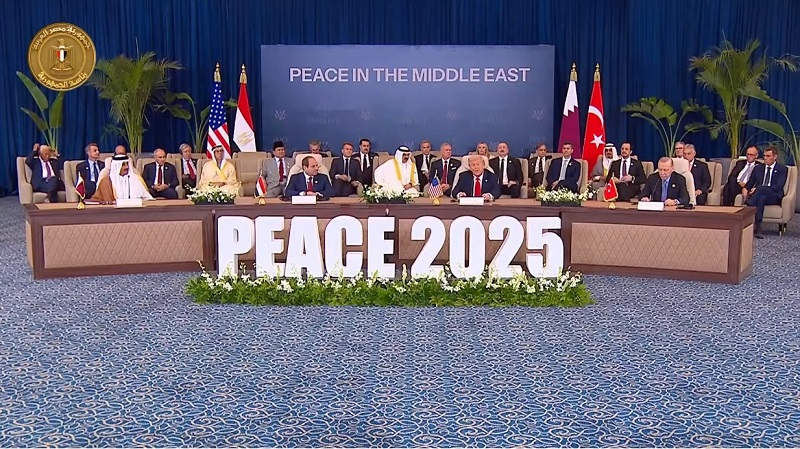
In a diplomatic scene few believed possible, U.S. President Donald J. Trump on Monday presided over the signing of a landmark Gaza Peace Agreement at the Sharm el-Sheikh Summit — a deal hailed by global leaders as a “turning point for the Middle East.” The accord, following two years of devastating conflict, promises not only a permanent ceasefire between Israel and Hamas but also a roadmap for reconstruction and regional security cooperation.
A Ceremony of High Stakes and Higher Symbolism
Under the glinting lights of the Tonino Lamborghini Convention Center, Trump stood flanked by Egyptian President Abdel Fattah el-Sisi, Qatari Emir Tamim bin Hamad Al Thani, and envoys from more than 20 nations. The mood was charged — part triumph, part disbelief.
“This historic agreement… those prayers of millions have finally been answered,” Trump declared, echoing the grandiose cadence that has defined his political persona. “Together, we have achieved what everyone said was impossible. At long last, we have peace in the Middle East.”
Applause filled the hall as pens met paper, ending a war that claimed over 67,000 Palestinian lives and left much of Gaza in ruins. For Israelis, the accord closed a tragic chapter that began on October 7, 2023, when Hamas’s attacks killed more than 1,200 people and led to the abduction of 250 hostages. By midday Monday, the final hostages were released, marking a poignant moment of closure.
The Road to Sharm el-Sheikh: Trump’s Return to the World Stage
The path to this moment was anything but straightforward. The Gaza conflict had become a humanitarian catastrophe and a geopolitical quagmire. Yet Trump — newly returned to the Oval Office for his second term — seized the opportunity to redefine his foreign policy legacy.
Drawing upon the architecture of the 2020 Abraham Accords, his administration reactivated a network of backchannel diplomacy, led by Jared Kushner and special envoy Steve Witkoff, shuttling between Cairo, Doha, and Jerusalem. The strategy combined transactional leverage with old-fashioned personal diplomacy: economic incentives, arms guarantees, and political pressure on both Israel and Hamas’s backers.
Key mediators included Egypt, Qatar, and Turkey, each playing a vital regional role. “The United States plays an essential role in achieving peace,” el-Sisi remarked during a bilateral meeting. Notably absent, however, was Israeli Prime Minister Benjamin Netanyahu, whose hesitation reflected deep unease within Israel’s governing coalition over the deal’s disarmament clauses.
Meanwhile, Palestinian Authority President Mahmoud Abbas — long sidelined in Gaza’s governance — attended the summit, signaling a tentative step toward Palestinian political unity not seen in over a decade.
Inside the 20-Point Plan: Aid, Security, and Governance
At the core of the peace deal lies an ambitious 20-point framework. Its early provisions, already underway, include:
- Immediate Humanitarian Access: Opening of secure aid corridors into Gaza under international supervision.
- Hostage and Prisoner Exchanges: Complete implementation monitored by the International Red Cross.
- Phased Israeli Withdrawal: A gradual IDF pullback contingent on Hamas’s cessation of hostilities.
Subsequent phases envision the demilitarization of Gaza, formation of an international “Board of Peace” led by the U.S., Egypt, and Qatar, and a massive reconstruction program estimated at $53 billion, coordinated by the World Bank and EU partners.
British Prime Minister Keir Starmer lauded the initiative as “a necessary leap toward sustainable peace,” while Pakistan’s Prime Minister Shehbaz Sharif went further, calling Trump “the most genuine candidate for the Nobel Peace Prize.”
Yet skepticism remains. Human rights organizations warn that without accountability mechanisms, Gaza’s rebuilding could be hampered by corruption and renewed factionalism. “We love peace,” said one displaced Gazan resident, “but who will rebuild our lives?”
A Polarizing Triumph: Trump’s Quest for Legacy
For Trump, the Sharm el-Sheikh accord represents both vindication and reinvention. After years of polarizing domestic politics, the deal reframes his international image — from nationalist disruptor to pragmatic dealmaker.
Even some critics in Washington have cautiously praised the accord’s scope. Former CIA analyst Robert Baer described it as “the most consequential U.S.-brokered peace initiative since Camp David.” Conservative outlets hailed it as “Trump’s Oslo,” while liberal commentators urged vigilance, noting the deal’s fragility and its reliance on Trump’s personal influence over Middle Eastern autocrats.
A City of Peace, Once Again
As the Red Sea sunset bathed the conference hall in gold, Trump boarded Air Force One for Washington, declaring to reporters: “It took 3,000 years to get here — but we got here.”
Whether the accord holds will depend on disciplined follow-through and trust among adversaries who have rarely known it. But for now, the Sharm el-Sheikh Summit stands as a symbolic rebirth — of diplomacy, pragmatism, and the enduring hope that the Middle East’s oldest wounds may finally begin to heal.